


100%
Online & async

45 hours
Duration

Language

UNIMIAMI
Official qualification
Introduction
IntroductionThis Software Design and Architecture course will teach you the fundamentals of software architecture, including computer programming concepts and types of programming languages. You will also learn more advanced aspects, such as object-oriented programming and data model management. The software development process, from inception to validation and verification, provides participants with a comprehensive and structured view of an application's lifecycle. Object-oriented programming requires a deep understanding of fundamental principles such as inheritance, modularity, and polymorphism. Students will also learn data modeling, enabling them to build conceptual, logical, and physical models.
Presentation
1 min 20 secs
Syllabus
SyllabusCertification
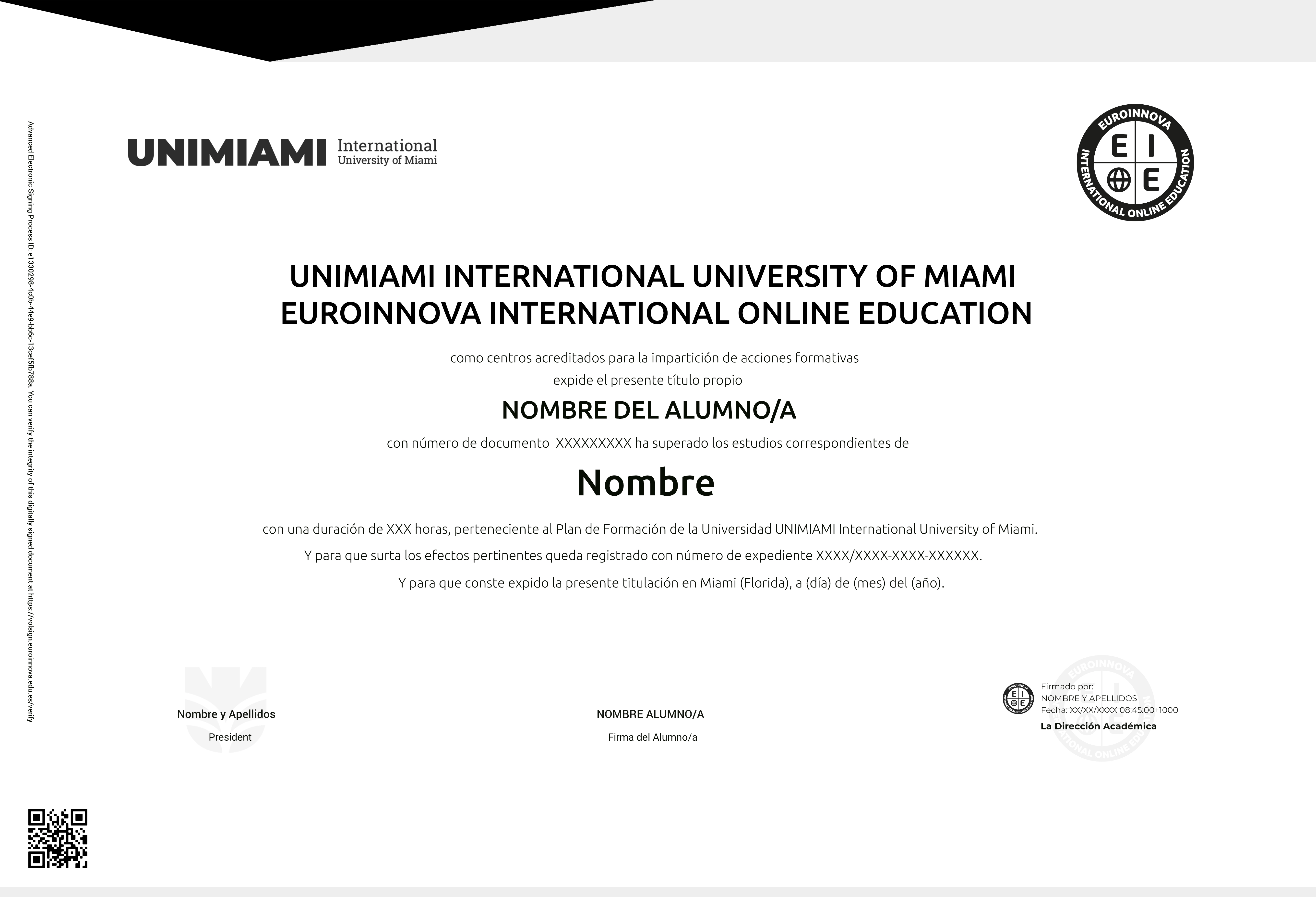
CertificationProfessional Certificate in Software Design and Architecture, lasting 45 hours and worth 1 academic credit, issued by UNIMIAMI
Job opportunities
Job opportunitiesSoftware Architect: Design complex systems and ensure cohesive integration. - Systems Analyst: Evaluate and improve software processes and components. - Technical Lead: Guide development teams with expertise in architecture. - Solutions Architect: Create scalable solutions tailored to business needs. - IT Consultant: Provide strategic advice on systems design and architecture.
Scholarships
ScholarshipsUNIMIAMI presents AVANZA
Commitment to Educational Democratization
A financial aid program for its students. With this, the university reaffirms its commitment to democratizing education and empowering future professionals, convinced that education is key to improving quality of life and reducing inequalities.


Methodology
Methodology
Truly personalized learning
Your style, interests, and level define the journey. You are the starting point.

Constructivism in action
Explore, experiment, and apply. Learning means understanding, not memorizing.

AI that accompanies you, not directs you
PHIA, our artificial intelligence assistant, guides you without limiting your autonomy.

Pressure-free evaluation
Continuous and adaptive feedback. Because learning is a process, not a number.